
Amsterdam, April 16, 2026 – A shared car that can also feed electricity back into the grid could generate nearly twice as much societal value within ten years as a shared car without this bidirectional charging capability. This is the outcome of an independent study into the societal benefits of shared cars conducted by Haskoning, commissioned by MyWheels. In the example city of Utrecht, the broader welfare benefits of 2,000 shared cars could amount to €11 million over 10 years. If half of this fleet is bidirectional, this could generate up to an additional €8 million under the right conditions.
Utrecht currently has around 1,000 shared cars, 170 of which are Renault 5s operated by MyWheels that are already capable of bidirectional charging. This technology, known as Vehicle-to-Grid (V2G), was introduced in Utrecht last year in collaboration with We Drive Solar. It enables not only the charging of electric vehicles, but also the return of electricity to the grid via the car’s battery. The Haskoning study assessed the societal impact of a scenario in which 1,000 additional V2G shared cars are deployed in Utrecht.
The study highlights the contribution of V2G shared cars in reducing grid congestion. In Utrecht, there is currently a waiting list of 63 to 72 megawatts (MW) of requested consumption capacity. By 2027, the 1,000 V2G shared cars could already supply 3.7 MW of flexible capacity back to the grid. Over the next 10 years, this amounts to 35,000 MWh of electricity during peak hours.
As households become more sustainable with heat pumps, solar panels, and electric vehicles, electricity demand in residential areas increases significantly, especially during evening peaks. V2G shared cars can act as a buffer at precisely those moments by feeding back green energy stored during the day. In this way, V2G shared cars help sustain the energy transition in both new developments and existing neighborhoods. If all potential returned electricity during peak hours is fully used for making existing housing more sustainable, the societal value of the 1,000 V2G shared cars could rise to approximately €8 million.
The study shows that one shared car in Utrecht replaces an average of 7.1 privately owned cars. Across the full fleet and over a ten-year period, this frees up more than 120,000 square meters of parking space—comparable to nearly 17 football fields. The societal value of this freed space is estimated at around €8.5 million.
By shifting from private cars to electric shared cars, Utrecht will save more than 14,000 tonnes of CO₂ over ten years. Emissions of particulate matter (PM2.5 and PM10) and nitrogen oxides (NOx) also decrease measurably, improving air quality. This could result in up to €2 million in societal climate benefits. V2G technology offers an additional environmental advantage: by feeding electricity back into the grid, more than 1,200 tonnes of CO₂ can be saved on top of that. The total reduction of over 15,000 tonnes of CO₂ is equivalent to the emissions from approximately 130 million fossil-fuel car kilometers.
“At Haskoning, we connect the energy and mobility transitions to concrete spatial choices. Based on our research, we demonstrate, among other things, the impact shared cars have on reducing parking pressure. Saving 120,000 m², equivalent to 8,000 parking spaces, means more room for housing, greenery, and quality of life—thus contributing to major societal challenges such as the housing shortage,” says Hannah Habekotté of Haskoning.
“This study confirms the enormous potential of V2G shared cars as a solution to several urgent societal challenges. Shared cars with bidirectional charging contribute simultaneously to both the mobility and energy transitions. By relieving pressure on the electricity grid, businesses can reconnect to the grid and progress can be made on housing development. V2G shared cars literally give the economy more breathing room,” says Laurens van de Vijver, CEO of MyWheels.
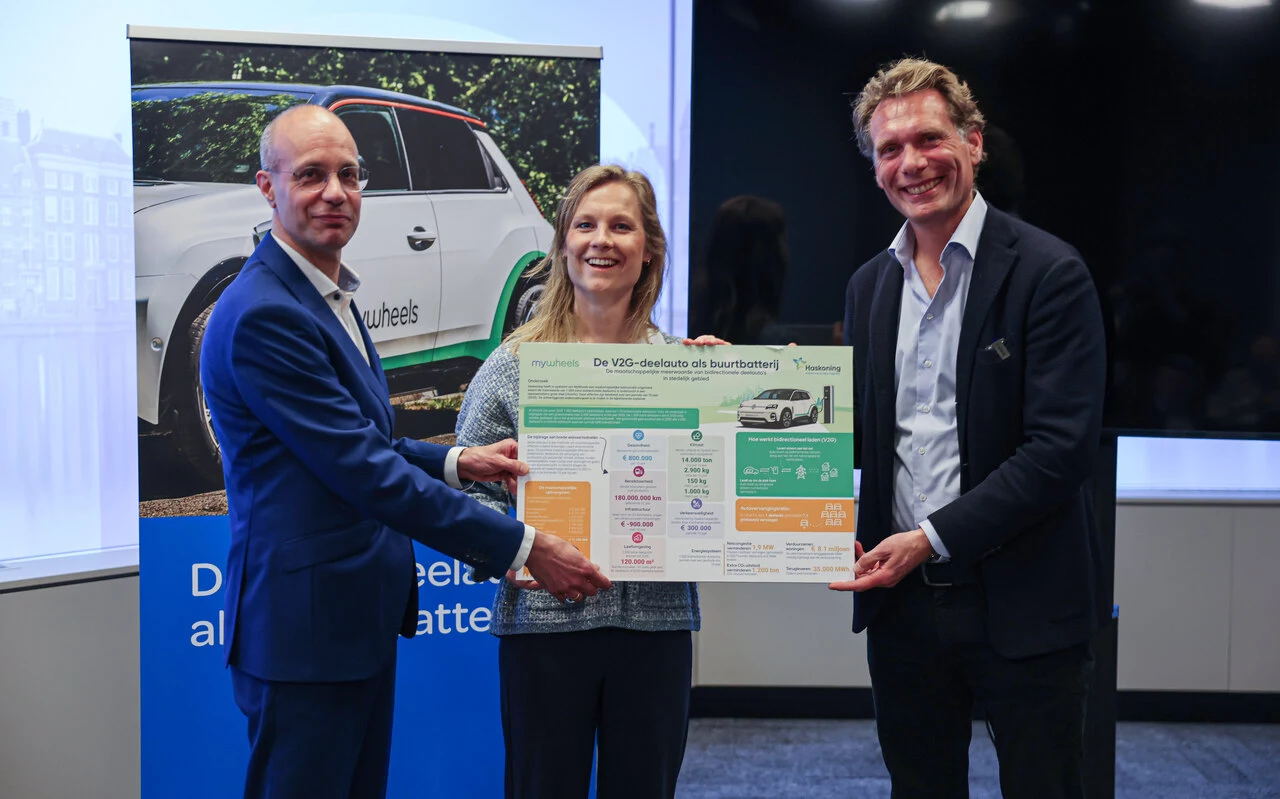
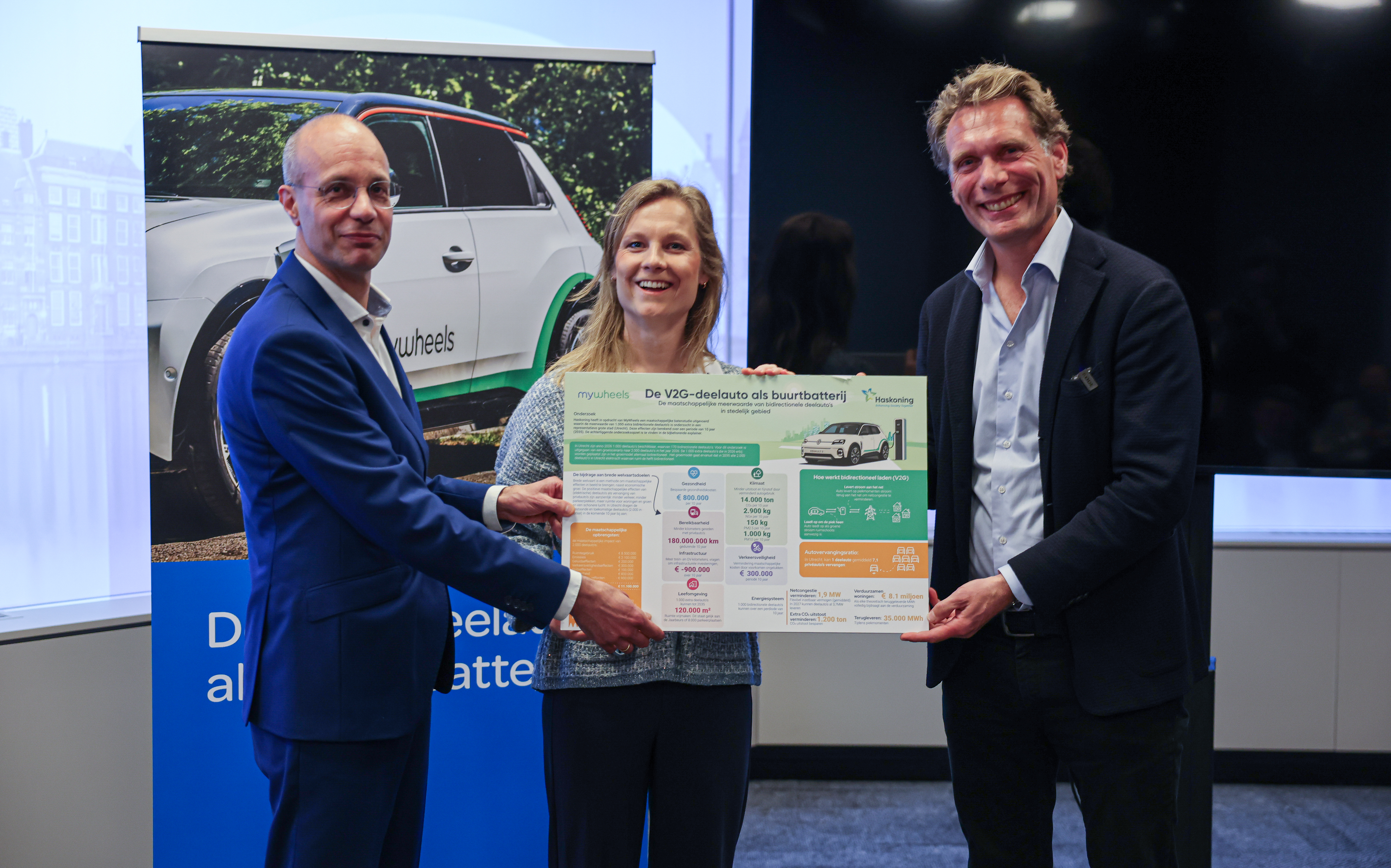
In the photo: the presentation of the report at Nieuwspoort (from left to right): Jan de Wit (Haskoning), Jantine Zwinkels (Member of Parliament, CDA), Laurens van de Vijver (MyWheels).
The analysis was conducted by Haskoning on behalf of MyWheels. It examines a ten-year impact period (2026–2035). Monetary effects were calculated based on key figures from CE Delft (“The Price of Travel,” 2022 and accompanying future outlook), Mobility in the Netherlands (CBS), the Welfare and Living Environment scenarios (WLO 2025), and the societal cost of grid congestion (Ecorys 2025). The study also analyzed usage patterns of MyWheels shared cars and the effects of existing (V2G) shared cars in Utrecht. Based on growth models, it calculated the potential modal shift and car replacement ratio among promising target groups in the two cities. Societal effects were calculated based on modal shift and the redistribution of trips that would normally be made by private cars. This results in an overview of societal benefits contributing to broad welfare objectives. In addition, the study examined the additional impact of bidirectional shared cars on the energy system and grid congestion.
The report can be viewed here: https://mywheels.nl/deelauto/v2g-rapport
Haskoning is an international consultancy and engineering firm for the natural and built environment. Guided by our purpose, Enhancing Society Together, our 6,800 professionals help clients worldwide with sustainable and leading solutions.
As an independent company without external shareholders, we determine our own course, in line with our values and in the interest of our clients, colleagues, and society. Haskoning was founded in 1881 and has held the Royal designation since 1981. www.haskoning.nl
MyWheels is a car-sharing platform with over 250,000 members and offers the largest and most diverse fleet of electric shared cars in the Netherlands. Together with 800 volunteer “Key Figures,” we make it possible for everyone to enjoy cars in an environmentally friendly and cost-efficient way, without owning one. This creates more space on the streets, more room for greenery, and contributes significantly to the environment. MyWheels is also taking the next step in the energy transition with partner We Drive Solar. Residents of Utrecht are the first in the Netherlands to experience at scale the positive impact of a “driving neighborhood battery.”
More information: https://mywheels.nl/